What 214 running shoes show about rocker and stack in 2026
Published 2026-10-04 · from the open ShoeGeometry dataset (version 2026-10-04) · newest version of each model unless stated
Four findings
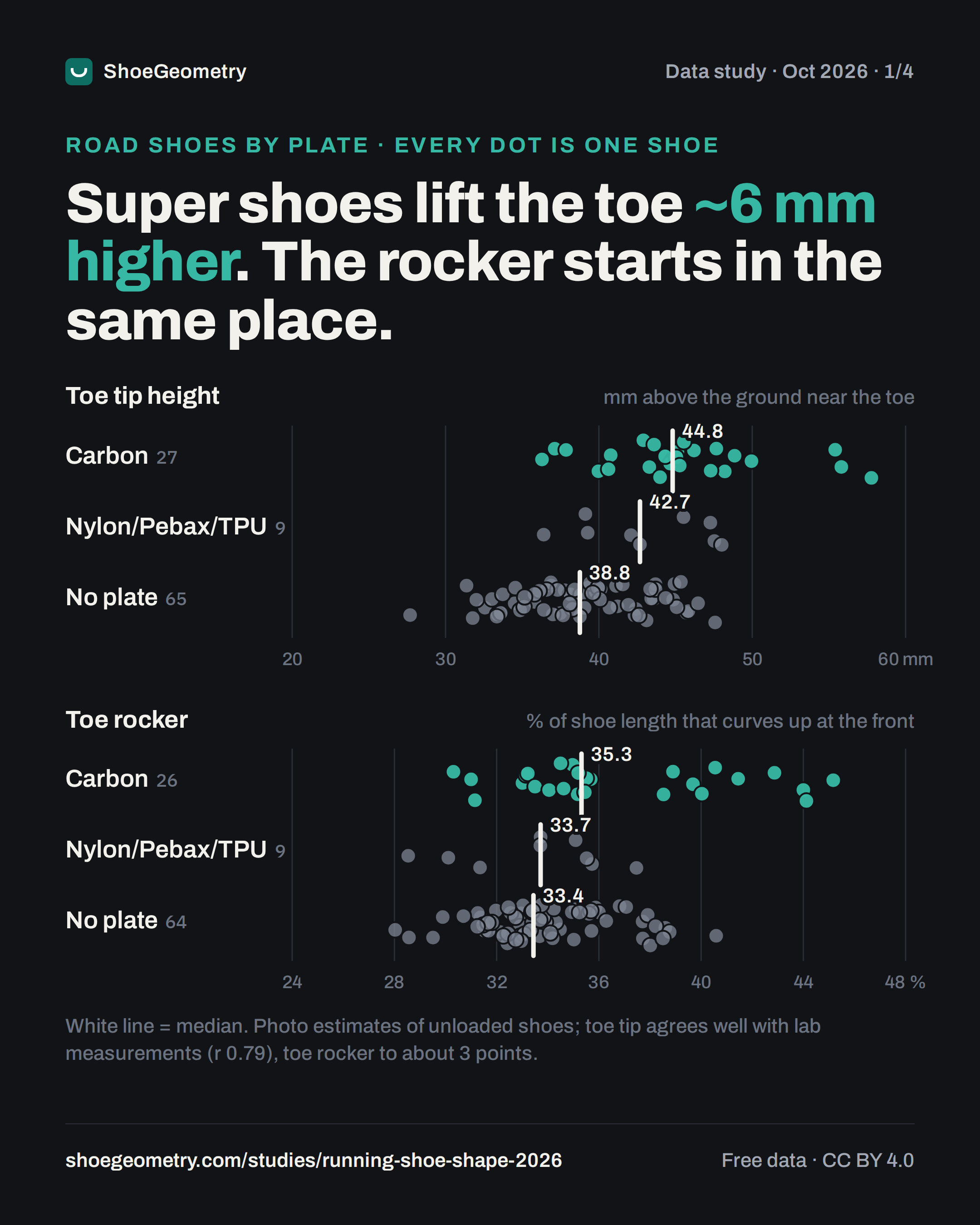
- Carbon super shoes lift the toe about 6 mm higher than unplated road shoes, but their rocker starts in about the same place.
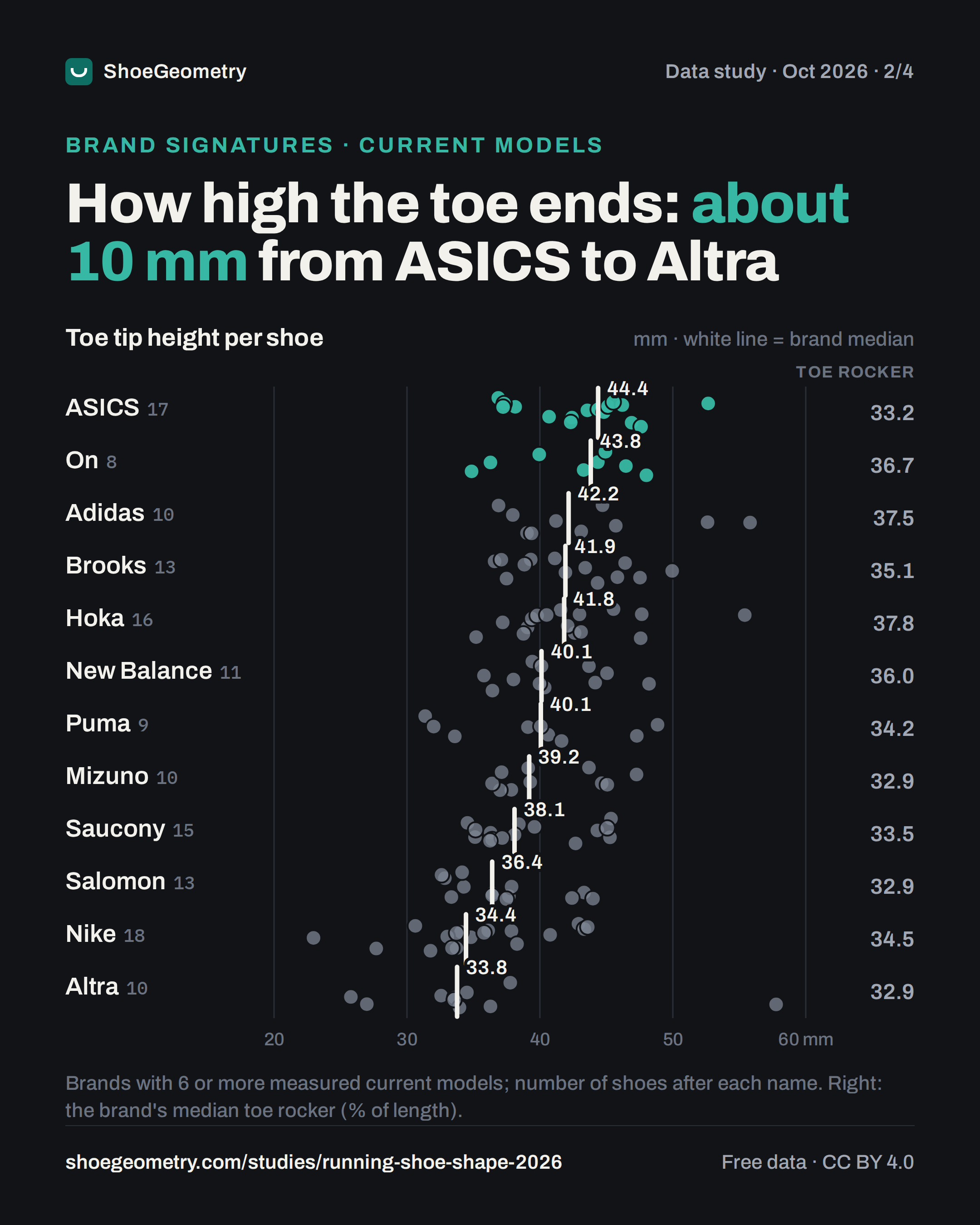
- Brands have signatures: ASICS and On lift the toe most, Nike and Altra least, about 10 mm apart. Hoka and adidas have the longest toe rockers.
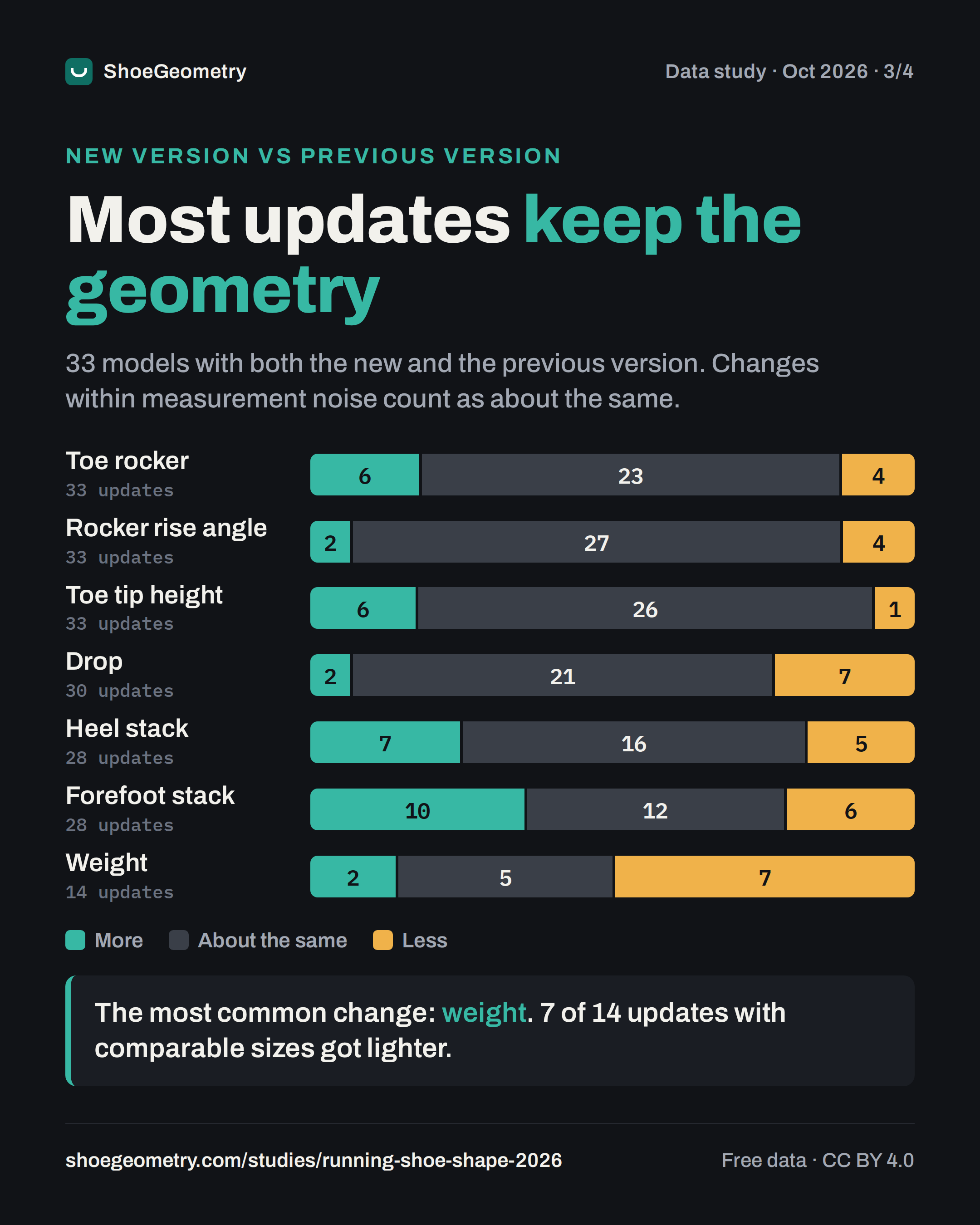
- New versions change less than launch marketing suggests: most keep the same rocker, stack and drop; half get lighter.
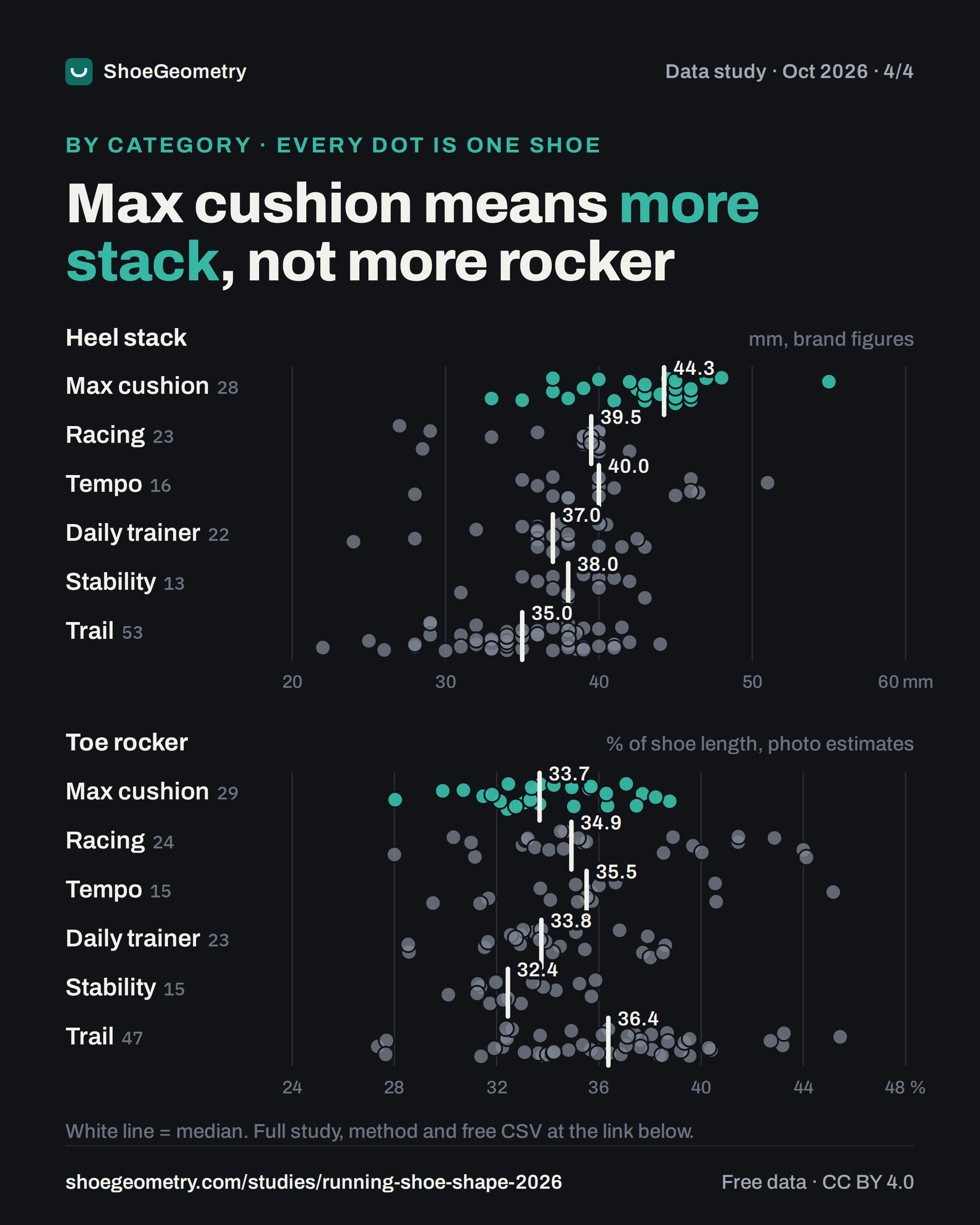
- Max cushion is about stack, not rocker: 7 mm more heel than daily trainers, with a similar toe rocker.
1. Super shoes: a higher toe, not an earlier rocker
Among current road shoes, carbon-plated models end with the toe 6 mm higher off the ground than unplated ones. That is clearly beyond the photo method's noise. The share of the shoe that curves up at the front differs by only 2 points, which is inside it, and the rise angle by under 2 degrees. Plated racers also carry 2 mm less drop and weigh far less, so the plate is one of several differences, not the only one.
| Road shoes | Shoes | Heel | Drop | Toe tip height | Toe rocker | Rise angle |
|---|---|---|---|---|---|---|
| Carbon plate | 28 | 40.0 mm | 6.0 mm | 44.8 mm | 35.3 % | 29.7° |
| Nylon, Pebax or TPU plate | 9 | 44.5 mm | 8.0 mm | 42.7 mm | 33.7 % | 30.1° |
| No plate | 69 | 39.0 mm | 8.0 mm | 38.8 mm | 33.4 % | 28.0° |
Medians. Toe tip height is the underside of the sole at 97 % of length, for a 300 mm shoe; toe rocker is the share of length from where the forefoot curve leaves the ground to the toe. Four road shoes whose plate is not recorded are left out. Corrected on 4 October 2026: an earlier version of this row also counted those four shoes.
2. Brand signatures
Brands with at least 6 measured current models. Toe tip height, which agrees well with lab measurements, separates brands by about 10 mm: ASICS and On end high, Nike and Altra low. Toe rocker spreads less, about 5 points from Hoka and adidas down to Altra, Mizuno and Salomon. The photo method resolves differences of about 3 points or more, so a brand median based on 10 or more shoes is meaningful at that size, while single shoes are not.
Median toe tip height (bars start at 30 mm). Number of shoes in brackets.
| Brand | Shoes | Toe tip height | Toe rocker |
|---|---|---|---|
| ASICS | 17 | 44.4 mm | 33.2 % |
| On | 8 | 43.8 mm | 36.7 % |
| Adidas | 10 | 42.2 mm | 37.5 % |
| Brooks | 13 | 41.9 mm | 35.1 % |
| Hoka | 16 | 41.8 mm | 37.8 % |
| New Balance | 11 | 40.1 mm | 36.0 % |
| Puma | 9 | 40.1 mm | 34.2 % |
| Mizuno | 10 | 39.2 mm | 32.9 % |
| Saucony | 14 | 38.1 mm | 33.5 % |
| Salomon | 11 | 36.4 mm | 32.9 % |
| Nike | 17 | 34.4 mm | 34.5 % |
| Altra | 10 | 33.8 mm | 32.9 % |
3. New versions change less than you would think
For 33 models we have both the current and the previous version. Counting only changes larger than the measurement noise (1 mm for stack and drop, 8 g for weight in the same size, 3 points for toe rocker, 5 mm for toe tip, 3° for the rise angle), most updates keep the geometry. Toe rocker stayed the same in 23 of 33, the rise angle in 27, and heel stack in 16 of 28. The most common change was weight: half of the updates with comparable weights got lighter.
| Measure | Model updates | More | About the same | Less |
|---|---|---|---|---|
| Heel stack | 28 | 7 | 16 | 5 |
| Forefoot stack | 28 | 10 | 12 | 6 |
| Drop | 30 | 2 | 21 | 7 |
| Weight (same size) | 14 | 2 | 5 | 7 |
| Toe rocker | 33 | 6 | 23 | 4 |
| Toe tip height | 33 | 6 | 26 | 1 |
| Rocker rise angle | 33 | 2 | 27 | 4 |
Every pair is listed, with what changed, on What changed in new versions.
4. Max cushion is about stack, not rocker
Max-cushion shoes stand 7 mm taller at the heel than daily trainers, but their toe rocker is the same and the toe ends only about 2 mm higher. The highest toe tips belong to racing and tempo shoes. Trail shoes have the longest toe rockers but low toe tips: a longer, gentler curve.
| Category | Shoes | Heel stack | Toe rocker | Toe tip height |
|---|---|---|---|---|
| Max cushion | 29 | 44.3 mm | 33.7 % | 40.1 mm |
| Daily trainer | 28 | 37.0 mm | 33.8 % | 38.3 mm |
| Tempo | 16 | 40.0 mm | 35.5 % | 43.6 mm |
| Racing | 25 | 39.5 mm | 34.9 % | 44.7 mm |
| Stability | 15 | 38.0 mm | 32.4 % | 38.1 mm |
| Trail | 56 | 35.0 mm | 36.4 % | 37.4 mm |
How this was measured, and its limits
- Stack, drop and weight are brand figures; rocker, toe tip and heel values are estimated from several product photos per shoe (the median of the photos is used). Shoes are unloaded; under body weight the toe drops and the rocker flattens.
- Against an independent lab, toe tip height and rise angle rank shoes well, toe rocker only for clear differences (accuracy). The findings above use differences larger than that noise.
- The catalogue is mostly popular 2025–26 models; groups of a few shoes are examples, not patterns. Medians, not means.
- Numbers are frozen at the 2026-10-04 dataset; the live dataset keeps growing.
Use these numbers
Free to quote and republish with credit (CC BY 4.0). Suggested citation:
ShoeGeometry (2026). What 214 running shoes show about rocker and stack in 2026. https://shoegeometry.com/studies/running-shoe-shape-2026. Data: ShoeGeometry running-shoe geometry dataset, version 2026-10-04, CC BY 4.0.
Share images
Four slides (1080×1350) for posts and threads, free to share with the link. Open one and save it.