Hoka Restore TC vs KURU Quantum 2
Last updated 2026-10-29 · the comparison recomputes itself when either shoe’s data changes
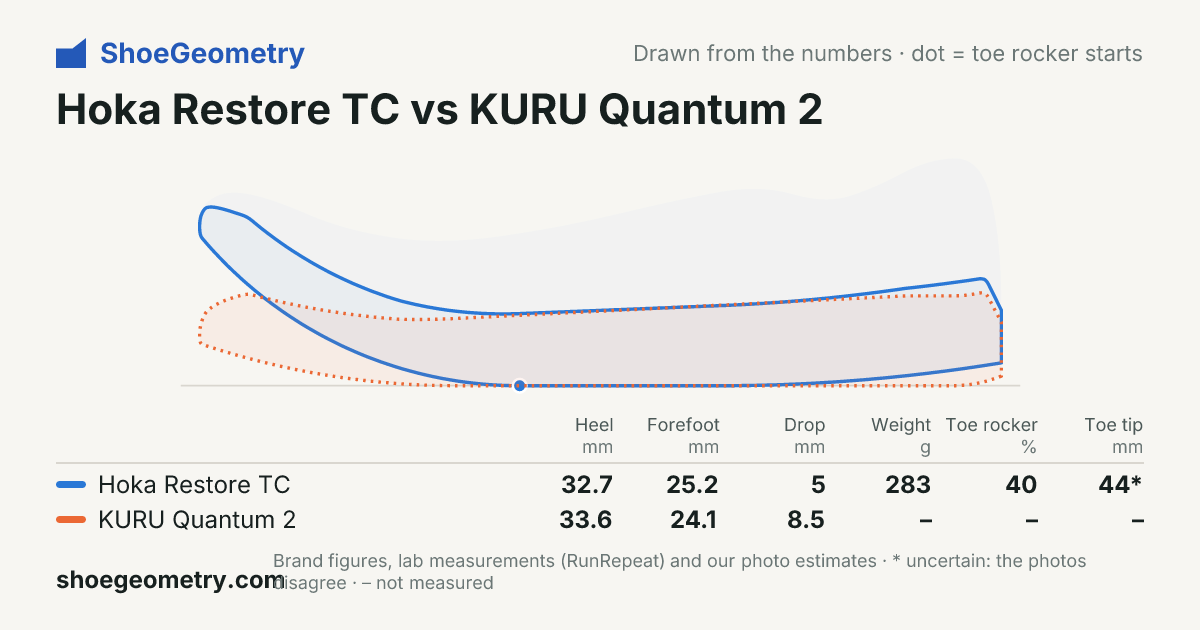
Two shoes compared on measured geometry. Each cell carries a provenance badge; open a shoe for sources.
- Hoka Restore TC33/25 mm · toe rocker 40 % · heel bevel 12 %
- KURU Quantum 234/24 mm · toe rocker not measured
Which suits you
| If you want | Pick | Because |
|---|---|---|
| More cushioning under the heel | About the same | 32.7 vs 33.6 mm heel stack |
| More under the forefoot | About the same | 25.2 vs 24.1 mm forefoot stack |
| A lower drop | Hoka Restore TC | 5 vs 8.5 mm drop |
| A stiffer, snappier forefoot | About the same | 34 vs 41 /100 stiffness |
| A wider base under the forefoot | About the same | 116 vs 117.2 mm forefoot base |
From the values below, with differences inside measurement noise shown as about the same. This describes the shoes, not what is right for your feet; comfort in the first few runs decides.
| Metric | Hoka Restore TC Walking · Road | KURU Quantum 2 Walking · Road |
|---|---|---|
| Heel-to-toe drop | 5 mmStated | 8.5 mmStated |
| Heel-to-toe drop (lab) | 7.5 mmMeasured | 9.5 mmMeasured |
| Heel stack | 32.7 mmMeasured | 33.6 mmMeasured |
| Heel stack (lab) | 32.7 mmMeasured | 33.6 mmMeasured |
| Forefoot stack | 25.2 mmMeasured | 24.1 mmMeasured |
| Forefoot stack (lab) | 25.2 mmMeasured | 24.1 mmMeasured |
| Weight | 283 gStated | — |
| Toe rocker | 40 %est. | — |
| Rocker radius | 52 %est. | — |
| Rocker rise angle | 26 deg*est. | — |
| Rocker angle at toe | 56 degest. | — |
| Toe tip over ground | 44 mm*est. | — |
| Visible rocker lift onset | 73.8 %est. | — |
| Toe spring (relative) | 20.5 %est. | — |
| Heel bevel length | 11.7 %*est. | — |
| Heel bevel height | 8 mm*est. | — |
| Midsole width (forefoot) | 116 mmMeasured | 117.2 mmMeasured |
| Midsole width (heel) | 104 mmMeasured | 93 mmMeasured |
| Interior forefoot width | 92.9 mmMeasured | 95.9 mmMeasured |
| Toebox width | 70.5 mmMeasured | 74.6 mmMeasured |
| Longitudinal stiffness | 34Derived | 41Derived |
| Plate | No plate | No plate |
| Primary foam | — | KURUCLOUD |
| List price | $110 | $169 |
Key differences
- Hoka Restore TC's heel-to-toe drop is 5 mm, 3.5 mm lower than KURU Quantum 2's 8.5 mm.
- Heel stack is about the same: 32.7 mm for Hoka Restore TC, 33.6 mm for KURU Quantum 2.
- Hoka Restore TC's forefoot stack is 25.2 mm, 1.1 mm thicker than KURU Quantum 2's 24.1 mm.
More comparisons
Read more about both shoes
We measure the shape. For how they feel over many miles, and for lab tests of cushioning, grip and fit:
Independent sites; we are not affiliated with them.
Share or embed
Embed on your site, blog or forum
Image with a link back:
<a href="https://shoegeometry.com/compare/hoka-restore-tc-vs-kuru-quantum-2"><img src="https://shoegeometry.com/compare/hoka-restore-tc-vs-kuru-quantum-2/share.png" alt="Hoka Restore TC vs KURU Quantum 2: running-shoe geometry (ShoeGeometry)" width="600" height="315" style="max-width:100%;height:auto"></a>
Live embed (updates when we measure more):
<iframe src="https://shoegeometry.com/embed/compare/hoka-restore-tc-vs-kuru-quantum-2" title="Hoka Restore TC vs KURU Quantum 2 (ShoeGeometry)" width="100%" height="580" style="border:0;max-width:640px" loading="lazy"></iframe> <p><a href="https://shoegeometry.com/compare/hoka-restore-tc-vs-kuru-quantum-2">Hoka Restore TC vs KURU Quantum 2</a>: running-shoe geometry from ShoeGeometry</p>
Free to use with the link back (CC BY 4.0). Lab measurements are credited to the lab that made them.