Arc'teryx Norvan LD 4 vs Inov-8 Trailfly V2
Last updated 2026-11-14 · the comparison recomputes itself when either shoe’s data changes
Two shoes compared on measured geometry. Each cell carries a provenance badge; open a shoe for sources.
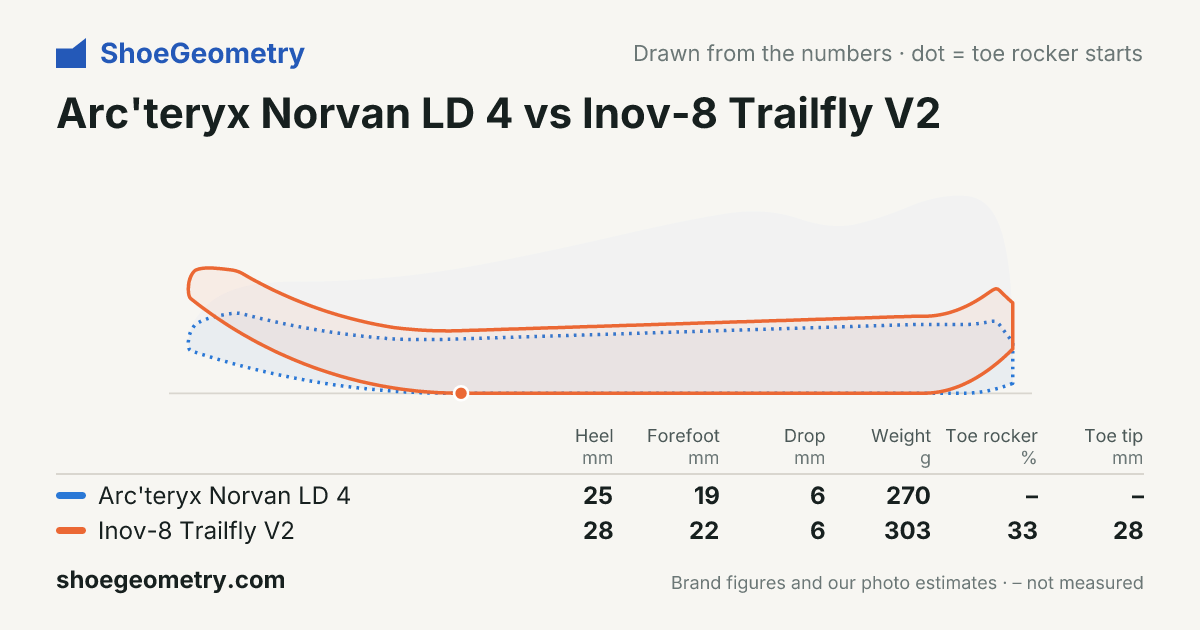
- Arc'teryx Norvan LD 425/19 mm · toe rocker not measured
- Inov-8 Trailfly V228/22 mm · toe rocker 33 % · heel bevel 5 %
Which suits you
| If you want | Pick | Because |
|---|---|---|
| More cushioning under the heel | Inov-8 Trailfly V2 | 25 vs 28 mm heel stack |
| More under the forefoot | Inov-8 Trailfly V2 | 19 vs 22 mm forefoot stack |
| A lower drop | About the same | 6 vs 6 mm drop |
From the values below, with differences inside measurement noise shown as about the same. This describes the shoes, not what is right for your feet; comfort in the first few runs decides.
| Metric | Arc'teryx Norvan LD 4 Trail · Trail | Inov-8 Trailfly V2 Trail · Trail |
|---|---|---|
| Heel-to-toe drop | 6 mmStated | 6 mmStated |
| Heel-to-toe drop (lab) | — | 8.7 mmMeasured |
| Heel stack | 25 mmStated | 28 mmStated |
| Heel stack (lab) | — | 34 mmMeasured |
| Forefoot stack | 19 mmStated | 22 mmStated |
| Forefoot stack (lab) | — | 25.3 mmMeasured |
| Weight | 270 gStated | 303 gStated |
| Toe rocker | — | 33 %est. |
| Rocker radius | — | 53 %est. |
| Rocker rise angle | — | 24 degest. |
| Toe tip over ground | — | 28 mmest. |
| Visible rocker lift onset | — | 80 %est. |
| Heel bevel length | — | 5.1 %est. |
| Midsole width (forefoot) | — | 111 mmMeasured |
| Midsole width (heel) | — | 83.3 mmMeasured |
| Interior forefoot width | — | 98.8 mmMeasured |
| Toebox width | — | 80 mmMeasured |
| Longitudinal stiffness | — | 22Derived |
| Midsole firmness | — | 75Derived |
| Plate | Plate unknown | No plate |
| Primary foam | Dual-density compression EVA (45C with 55C medial heel zone, per RoadTrailRun) | POWERFLOW Pro |
| List price | $170 | $160 |
Key differences
- Heel-to-toe drop is about the same: 6 mm for Arc'teryx Norvan LD 4, 6 mm for Inov-8 Trailfly V2.
- Arc'teryx Norvan LD 4's heel stack is 25 mm, 3 mm thinner than Inov-8 Trailfly V2's 28 mm.
- Arc'teryx Norvan LD 4's forefoot stack is 19 mm, 3 mm thinner than Inov-8 Trailfly V2's 22 mm.
- Arc'teryx Norvan LD 4's weight is 270 g, 33 g lighter than Inov-8 Trailfly V2's 303 g.
More comparisons
Read more about both shoes
We measure the shape. For how they feel over many miles, and for lab tests of cushioning, grip and fit:
Arc'teryx Norvan LD 4
- Believe in the Run · tester review
Inov-8 Trailfly V2
- Believe in the Run · tester review
- RunRepeat · lab test
Independent sites; we are not affiliated with them.
Share or embed
Embed on your site, blog or forum
Image with a link back:
<a href="https://shoegeometry.com/compare/arc-teryx-norvan-ld-4-vs-inov-8-trailfly-v2"><img src="https://shoegeometry.com/compare/arc-teryx-norvan-ld-4-vs-inov-8-trailfly-v2/share.png" alt="Arc'teryx Norvan LD 4 vs Inov-8 Trailfly V2: running-shoe geometry (ShoeGeometry)" width="600" height="315" style="max-width:100%;height:auto"></a>
Live embed (updates when we measure more):
<iframe src="https://shoegeometry.com/embed/compare/arc-teryx-norvan-ld-4-vs-inov-8-trailfly-v2" title="Arc'teryx Norvan LD 4 vs Inov-8 Trailfly V2 (ShoeGeometry)" width="100%" height="580" style="border:0;max-width:640px" loading="lazy"></iframe> <p><a href="https://shoegeometry.com/compare/arc-teryx-norvan-ld-4-vs-inov-8-trailfly-v2">Arc'teryx Norvan LD 4 vs Inov-8 Trailfly V2</a>: running-shoe geometry from ShoeGeometry</p>
Free to use with the link back (CC BY 4.0). Lab measurements are credited to the lab that made them.