ASICS Metaspeed Ray vs Hoka Cielo X1 3.0
Last updated 2026-10-28 · the comparison recomputes itself when either shoe’s data changes
Two popular shoes in the same category, compared on measured geometry. Each cell carries a provenance badge; open a shoe for sources.
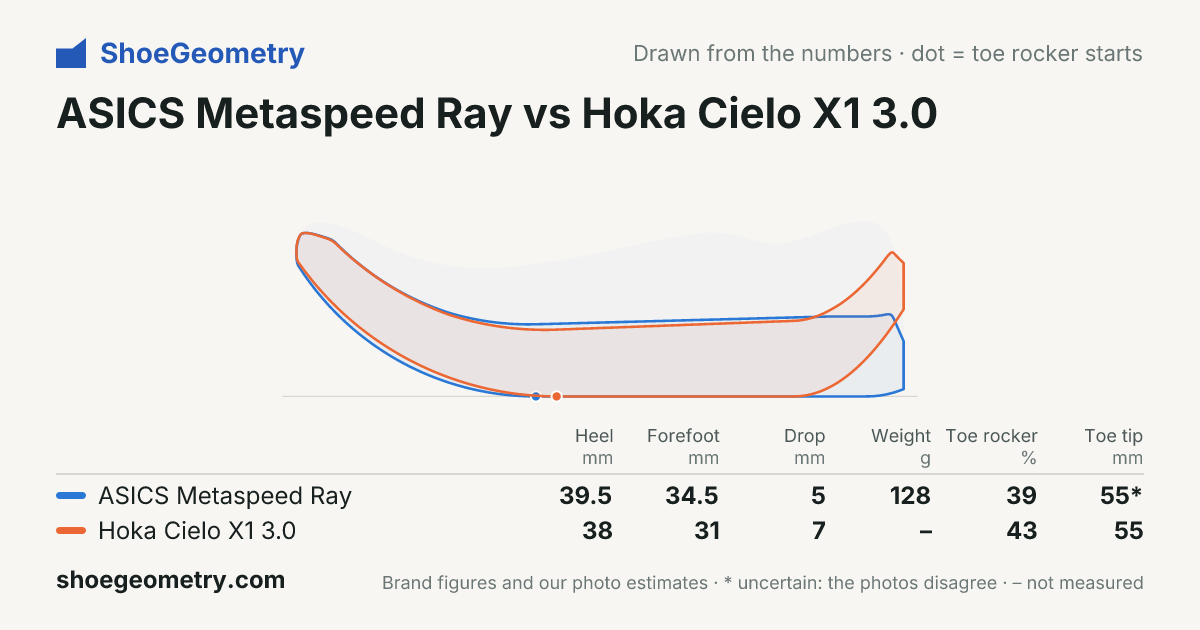
- ASICS Metaspeed Ray40/35 mm · toe rocker 39 %
- Hoka Cielo X1 3.038/31 mm · toe rocker 43 % · heel bevel 12 %
Which suits you
| If you want | Pick | Because |
|---|---|---|
| A smoother roll at toe-off | Hoka Cielo X1 3.0 | 39.5 vs 42.9 % toe rocker |
| More cushioning under the heel | About the same | 39.5 vs 38 mm heel stack |
| More under the forefoot | ASICS Metaspeed Ray | 34.5 vs 31 mm forefoot stack |
| A lower drop | ASICS Metaspeed Ray | 5 vs 7 mm drop |
| A stiffer, snappier forefoot | About the same | 44 vs 46 /100 stiffness |
| A firmer, more stable feel | Hoka Cielo X1 3.0 | 31 vs 48 /100 firmness |
| A wider base under the forefoot | Hoka Cielo X1 3.0 | 100.8 vs 107.6 mm forefoot base |
From the values below, with differences inside measurement noise shown as about the same. This describes the shoes, not what is right for your feet; comfort in the first few runs decides.
| Metric | ASICS Metaspeed Ray Racing · Road | Hoka Cielo X1 3.0 Racing · Road |
|---|---|---|
| Heel-to-toe drop | 5 mmStated | 7 mmStated |
| Heel-to-toe drop (lab) | 9.8 mmMeasured | 13.4 mmMeasured |
| Heel stack | 39.5 mmStated | 38 mmStated |
| Heel stack (lab) | 39.8 mmMeasured | 44.5 mmMeasured |
| Forefoot stack | 34.5 mmStated | 31 mmStated |
| Forefoot stack (lab) | 30 mmMeasured | 31.1 mmMeasured |
| Weight | 128 gStated | — |
| Toe rocker | 39 %est. | 43 %est. |
| Rocker radius | 46 %est. | 52 %est. |
| Rocker rise angle | — | 29 degest. |
| Rocker angle at toe | — | 57 degest. |
| Toe tip over ground | 55 mm*est. | 55 mmest. |
| Visible rocker lift onset | 75 %est. | 68.7 %est. |
| Toe spring (relative) | — | 23.9 %est. |
| Heel bevel length | — | 12.2 %est. |
| Heel bevel height | — | 34 mm*est. |
| Midsole width (forefoot) | 100.8 mmMeasured | 107.6 mmMeasured |
| Midsole width (heel) | 73 mmMeasured | 78.1 mmMeasured |
| Interior forefoot width | 91.3 mmMeasured | 91.4 mmMeasured |
| Toebox width | 69.6 mmMeasured | 70.4 mmMeasured |
| Longitudinal stiffness | 44Derived | 46Derived |
| Midsole firmness | 31Derived | 48Derived |
| Plate | Carbon plate | Carbon plate |
| Primary foam | FF LEAP | Dual-layer PEBA |
| List price | $300 | $275 |
Key differences
- ASICS Metaspeed Ray's heel-to-toe drop is 5 mm, 2 mm lower than Hoka Cielo X1 3.0's 7 mm.
- ASICS Metaspeed Ray's heel stack is 39.5 mm, 1.5 mm thicker than Hoka Cielo X1 3.0's 38 mm.
- ASICS Metaspeed Ray's forefoot stack is 34.5 mm, 3.5 mm thicker than Hoka Cielo X1 3.0's 31 mm.
- ASICS Metaspeed Ray's toe rocker is 39 % of length, 3 % of length shorter than Hoka Cielo X1 3.0's 43 % of length.
More comparisons
Read more about both shoes
We measure the shape. For how they feel over many miles, and for lab tests of cushioning, grip and fit:
ASICS Metaspeed Ray
- Believe in the Run · tester review
- RTINGS · lab test
- RunRepeat · lab test
Independent sites; we are not affiliated with them.
Share or embed
Embed on your site, blog or forum
Image with a link back:
<a href="https://shoegeometry.com/compare/asics-metaspeed-ray-vs-hoka-cielo-x1-3-0"><img src="https://shoegeometry.com/compare/asics-metaspeed-ray-vs-hoka-cielo-x1-3-0/share.png" alt="ASICS Metaspeed Ray vs Hoka Cielo X1 3.0: running-shoe geometry (ShoeGeometry)" width="600" height="315" style="max-width:100%;height:auto"></a>
Live embed (updates when we measure more):
<iframe src="https://shoegeometry.com/embed/compare/asics-metaspeed-ray-vs-hoka-cielo-x1-3-0" title="ASICS Metaspeed Ray vs Hoka Cielo X1 3.0 (ShoeGeometry)" width="100%" height="580" style="border:0;max-width:640px" loading="lazy"></iframe> <p><a href="https://shoegeometry.com/compare/asics-metaspeed-ray-vs-hoka-cielo-x1-3-0">ASICS Metaspeed Ray vs Hoka Cielo X1 3.0</a>: running-shoe geometry from ShoeGeometry</p>
Free to use with the link back (CC BY 4.0). Lab measurements are credited to the lab that made them.