Skechers Max Cushioning Elite 2.0
Last updated 2026-10-29 · methods as of 2026-10-08 · change history · why sources disagree
A walking shoe, measured like the running shoes and compared here with running, walking and work shoes alike. It is not in the running lists and guides; walking shoes and shoes for standing all day are compared on their own page.
Not estimated from photos yet. ShoeGeometry’s own estimates of the toe rocker and heel bevel appear here once side-profile photos of this shoe are analysed (how).
At a glance
Figures from brands, labs and retailers, each credited below.
- Heel-to-toe drop
- 6mmStated
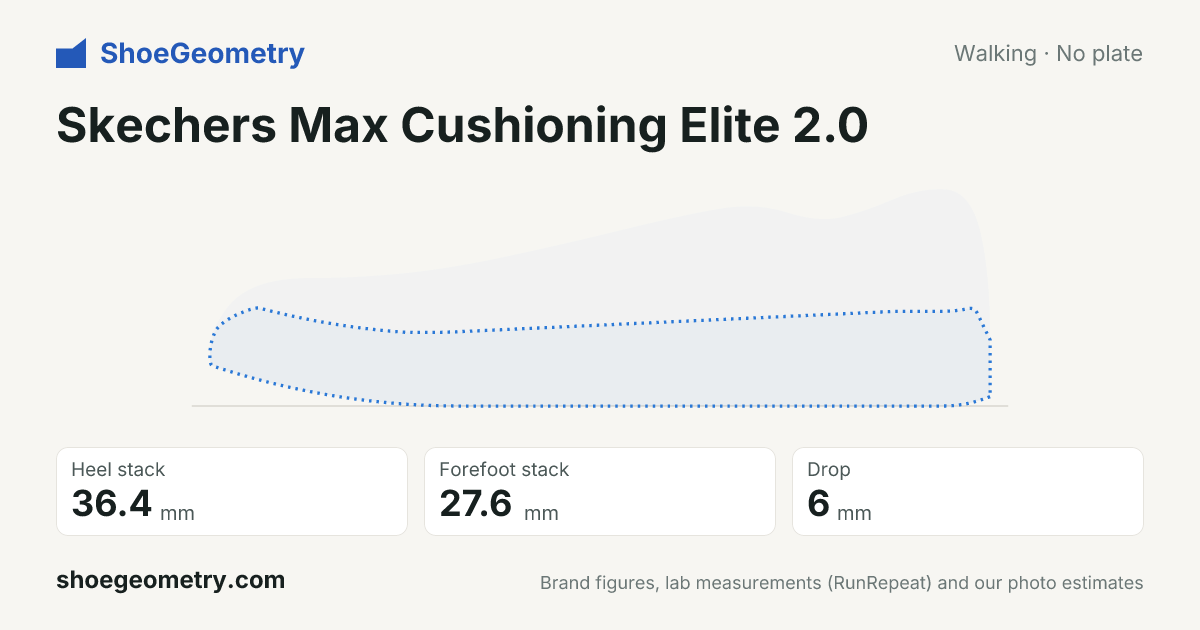
- Stack, heel / forefoot
- 36.4 / 27.6mmMeasured
- Weight
- not measured yet
- Stiffness / firmness
- 20 / —of 100Derived
- Plate
- No plate
- Primary foam
- ULTRA GO
How it compares
- Skechers Max Cushioning Elite 2.0's heel-to-toe drop is 6 mm, about the catalogue median of 6 mm (26% of the 227 other current shoes are lower).
- Skechers Max Cushioning Elite 2.0's heel stack is 36.4 mm, thinner than the catalogue median of 38 mm (40% of the 226 other current shoes are thinner).
- Skechers Max Cushioning Elite 2.0's forefoot stack is 27.6 mm, thinner than the catalogue median of 30.3 mm (27% of the 223 other current shoes are thinner).
- 4 shoes with similar geometry from other lines.
Differences smaller than the precision of the sources (about 1 mm of stack, 8 g, or the spread between photos for photo estimates) are reported as about the same.
Specifications
- Heel-to-toe drop Manufacturer stated
- 6mm
- Heel stack Externally measured
- 36.4mm
- Forefoot stack Externally measured
- 27.6mm
- Weight
- No approved value yet.
These figures do not add up: heel 36.4 − forefoot 27.6 mm is not the stated 6 mm drop. They come from different sources or measuring points (why sources disagree); every recorded value is listed under Technical detail below.
Measured in a lab (RunRepeat): heel 36.4 mm · forefoot 27.6 mm · drop 8.8 mm, taken at the points World Athletics uses (12 % and 75 % of the length), the same on every shoe. The figures above are the brand’s where it states them; labs and brands often measure at different points (why sources disagree).
- Plate
- No plate
- Primary foam
- ULTRA GO
- List price
- $105
Plate, foam and price from Sold out | SKECHERS.
Geometry
- Toe rocker not measured: typical curve drawn
- Heel bevel not measured: generic rounding drawn
Percent values are relative to shoe length so they compare across images and sizes; widths in millimetres are lab measurements from the cited source, while toe tip and heel heights in millimetres are photo estimates converted for a men’s US 9 (assumed 300 mm long), so approximate. See how rocker geometry is defined.
- Midsole width (forefoot) Externally measured
- 109.6mm
- Midsole width (heel) Externally measured
- 96.9mm
Stiffness
- Longitudinal stiffness Derived
- 20/ 100
Lab reading: 11.8 N, force to bend the shoe 30° (lab bending test); the score is our 0–100 rescaling of it.
How it compares
Compare:Skechers Max Cushioning Elite 2.0 vs Brooks Ghost Max LSkechers Max Cushioning Elite 2.0 vs Brooks Ghost Max Slip ResistantSkechers Max Cushioning Elite 2.0 vs Hoka Restore TC
Wrong value? Missing data? Tell me
Read more about this shoe
We measure the shape. For how the Skechers Max Cushioning Elite 2.0 feels over many miles, and for lab tests of cushioning, grip and fit, read these:
Independent sites; we are not affiliated with them. Found automatically each week.
Share or embed
Embed on your site, blog or forum
Image with a link back:
<a href="https://shoegeometry.com/shoes/skechers-max-cushioning-elite-2-0"><img src="https://shoegeometry.com/shoes/skechers-max-cushioning-elite-2-0/share.png" alt="Skechers Max Cushioning Elite 2.0: running-shoe geometry (ShoeGeometry)" width="600" height="315" style="max-width:100%;height:auto"></a>
Live embed (updates when we measure more):
<iframe src="https://shoegeometry.com/embed/shoes/skechers-max-cushioning-elite-2-0" title="Skechers Max Cushioning Elite 2.0 (ShoeGeometry)" width="100%" height="440" style="border:0;max-width:640px" loading="lazy"></iframe> <p><a href="https://shoegeometry.com/shoes/skechers-max-cushioning-elite-2-0">Skechers Max Cushioning Elite 2.0</a>: running-shoe geometry from ShoeGeometry</p>
Free to use with the link back (CC BY 4.0). Lab measurements are credited to the lab that made them.
Sources
Change history
What was recorded for this shoe, by day, newest first. A corrected or re-measured value shows what it replaced; earlier values stay in the technical detail below.
2026-10-29
- Heel-to-toe drop: 8.8 mm, lab measurement, RunRepeat
- Heel stack: 36.4 mm, lab measurement, RunRepeat
- Forefoot stack: 27.6 mm, lab measurement, RunRepeat
- Midsole width (forefoot): 109.6 mm, lab measurement, RunRepeat
- Midsole width (heel): 96.9 mm, lab measurement, RunRepeat
- Longitudinal stiffness: 20/100, derived, RunRepeat
- Heel-to-toe drop: 6 mm, brand figure, runnea.co.uk
- Photo estimates: toe rocker and toe tip, heel bevel, from 1 photo (method 0.3, 0.3-bc1)
Technical detail: every recorded value, method and version (7)
All approved observations
Every recorded value, including superseded ones. The displayed value per metric is chosen by precedence (measured › stated › derived › AI estimated), then confidence, then recency. 18 further observations awaiting review.
| Metric | Value | Class | Confidence | Method | Source | Recorded |
|---|---|---|---|---|---|---|
| Heel-to-toe drop | 8.8 mm | Measured | Medium | Lab test | RunRepeat | 2026-10-29 |
| Heel-to-toe drop | 6 mm | Stated | Medium | Spec listing | runnea.co.uk | 2026-10-29 |
| Heel stack | 36.4 mm | Measured | Medium | Lab test | RunRepeat | 2026-10-29 |
| Forefoot stack | 27.6 mm | Measured | Medium | Lab test | RunRepeat | 2026-10-29 |
| Midsole width (forefoot) | 109.6 mm | Measured | Medium | Lab test | RunRepeat | 2026-10-29 |
| Midsole width (heel) | 96.9 mm | Measured | Medium | Lab test | RunRepeat | 2026-10-29 |
| Longitudinal stiffness | 20 | Derived | Medium | Lab flex test | RunRepeat | 2026-10-29 |
Classes: Manufacturer stated · Externally measured · AI estimated · Derived · User reported. Hover a method for its identifier and algorithm version.
Shoes with similar geometry
All 8 alternatives, softer, lighter… →Compare these →Closest current models from other lines by stack, drop, rocker, toe height, stiffness, firmness, weight and width, whichever both shoes have.

- Drop
- 6 mm
- Heel
- 36 mm
- Toe rocker
- 33%
Very close on every shared measure

- Drop
- 7 mm
- Heel
- 36 mm
- Toe rocker
- 36%
Very close on every shared measure

- Drop
- 8 mm
- Heel
- 35 mm
- Toe rocker
- 35%
vs this shoe: 2 mm more drop

- Drop
- 6 mm
- Heel
- 38 mm
- Toe rocker
- 31%
vs this shoe: stiffer